

How Do Humans And Animals Cause Weathering
Weathering is the breakdown of rocks and minerals at or near the Earth's surface. It is caused past chemical and concrete interactions with air, water, and living organisms. The variety of agents responsible for weathering means that the rate and extent of weathering is highly variable and depends on multiple processes and phenomena including the chemical composition of rocks, the water wheel, uplift from tectonic processes, and regional biodiversity. Over thousands to many millions of years, the weathering and erosion of rocks affects Globe'southward surface features (that is, its topography), soil, nutrients on the country and in the ocean, and the composition of the atmosphere, which in turn affects global climate and ecosystems.
What is weathering?

Top: The weathering of granite, a stone rich in silicate minerals, crumbles the once hard rock into sand. Bottom: The weak acrid that results from CO2 dissolving in rainwater slowly dissolves limestone, here leaving to a honeycomb design in the limestone stone (bottom). Credits: Wikipedia (tiptop) and USGS (lesser)
The weathering of rocks occurs through both physical and chemical processes. Concrete weathering is the breakdown of rock into smaller pieces without altering the chemical composition of the rock. For instance, concrete weathering can happen equally the temperature changes, causing rocks to expand equally they warm and contract as they cool, resulting in cracks that lead to the breakup of the rock. Additional causes of physical weathering include the freezing and expansion of h2o in stone cracks, and tree roots that dig into rocks that tin divide them apart.
Chemic weathering occurs when the breakdown of rock results from chemic change in the stone, or the when the stone is dissolved abroad. The rate of these chemic reactions is affected by climatic weather such as precipitation and temperature, with water and warmer temperatures increasing the charge per unit. Found growth, aside from physically breaking up rocks, can too change the environmental chemistry (for example, increase acidity) contributing to chemical weathering.
Over thousands to many millions of years, the weathering of silicate rocks on country (rocks made of minerals that contain the element silica) is an important part of the carbon bike. Over long-time scales, significant amounts of carbon dioxide (a greenhouse gas) are removed from the temper when rainwater (H2O) mixes with CO2 to form carbonic acid (H2COiii). This weak acrid reacts with rocks, breaking them downward, resulting in the transport of carbon via rivers to the ocean, where it ultimately becomes buried in sea sediments to become limestone stone. In dissimilarity, the weathering of limestone past carbonic acid releases carbon dioxide into the atmosphere, just there is no net removal of CO2 from the temper as happens with the weathering of silicate rocks. The called-for of fossil fuels returns carbon to the atmosphere (as COii) at a charge per unit that is hundreds to thousands of times faster than it took to bury. This rate is so high that even though the warming produced past the increased COii increases the charge per unit of weathering of silicate rocks, which draws downwardly atmospheric CO2, is not nearly enough to get-go the increase in carbon dioxide added to the atmosphere by human activities. Visit the carbon and rock cycle pages to learn more than about how weathering is connected to other World organisation processes.
The weathering of rocks affects how much and what kind of rock is eroded by water, ice, current of air, and gravity, which can affect soil formation, and where various sedimentary rocks course over thousands to millions of years. Additionally, regional soil quality, nutrient levels (peculiarly nitrogen and phosphorus levels), are dependent on the type of rock that is weathered, which in turn affects local biodiversity. Ultimately, over millions of years, geologic changes in the uplift of land, driven past plate tectonics, alter the geographic location and amount of rock exposed for weathering.
Earth system model about weathering
The Earth system model below includes some of the processes and phenomena related to the carbon wheel. These processes operate at various rates and on different spatial and temporal scales. For example, carbon is transferred among plants and animals over relatively short time periods (hours-weeks), but the human extraction and burning of fossil fuels has altered the carbon cycle over decades, while weathering and volcanism bear upon the carbon bike over millions of years. Can you call up of boosted crusade and effect relationships between the parts of the carbon bicycle and other processes in the Globe system?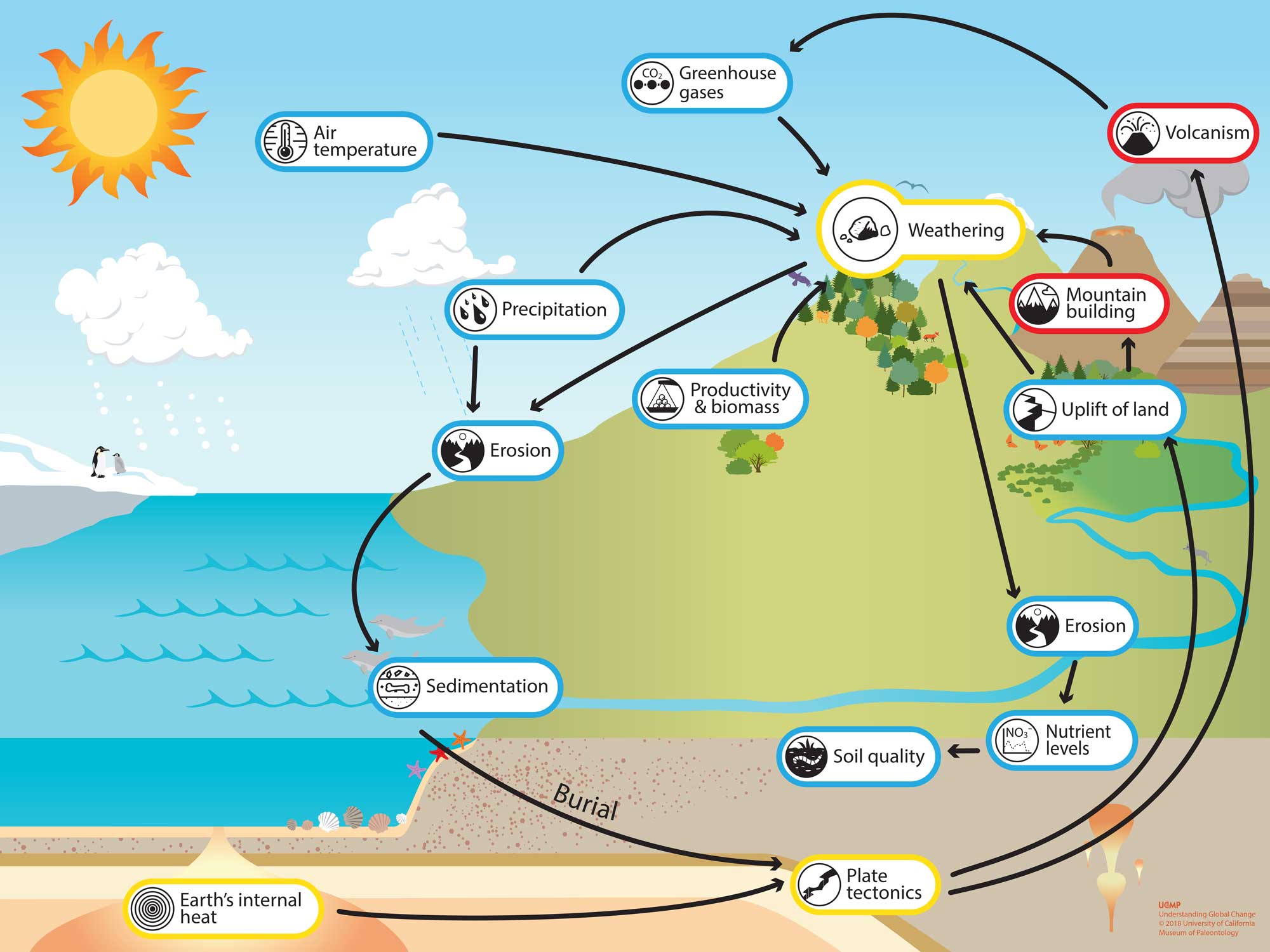
Explore the Globe System
Click the bolded terms (due east.m. erosion , rock cycle, and carbon cycle) on this page to learn more than about these procedure and phenomena. Alternatively, explore the Understanding Global Change Infographic and detect new topics that are of involvement and/or locally relevant to yous.
Links to Acquire More
- National Park Service: Weathering
- NASA Earth Observatory: The Slow Carbon Cycle
- USGS: What'southward the divergence between weathering and erosion?
Source: https://ugc.berkeley.edu/background-content/weathering/
Posted by: lizotteesethe.blogspot.com
0 Response to "How Do Humans And Animals Cause Weathering"
Post a Comment