

What Are The Shapes In An Animal Cell
Nosotros are aware of the fact that the cell is the structural and central unit of life. It is also the smallest and the most basic biological unit of living organisms. On the ground of the cellular organization, cells are further classified as eukaryotic and prokaryotic. Constitute cells and animal cells fall under the eukaryotic category.
Table of Contents
- Definition
- Explanation
- Diagram
- Construction
- Types
- Conclusion
Allow us have a detailed overview of the brute prison cell, its types, diagram and structure.
Brute Cell Definition
"An beast cell is a type of eukaryotic prison cell that lacks a cell wall and has a true, membrane-spring nucleus along with other cellular organelles."
Caption
Fauna cells range in size from a few microscopic microns to a few millimetres. The largest known animal prison cell is the ostrich egg, which can stretch over 5.1 inches beyond and weighs about one.4 kilograms. This is in stark dissimilarity to the neuron in the human torso, which is only 100 microns across.
The shape of brute cells as well varies, with some being flat, others oval or rod-shaped. There are also more intriguing shapes such as curved, spherical, concave and rectangular. Most of the cells are microscopic in size and can only be seen under the microscope.
Every bit stated earlier, animal cells are eukaryotic cells with a membrane-bound nucleus. Furthermore, these cells exhibit the presence of DNA within the nucleus. They besides contain other membrane-bound organelles and cellular structures which carry out specific functions necessary for a jail cell to role properly.
Animal Cell Diagram
The diagram given beneath depicts the structural arrangement of the fauna cell. The diverse prison cell organelles nowadays in an animal jail cell are clearly marked in the animal cell diagram provided below.
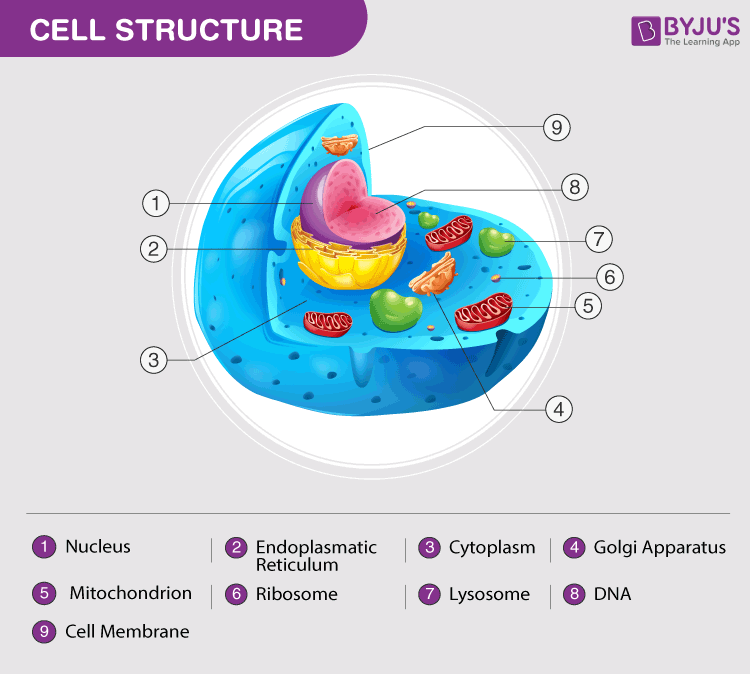
Fauna prison cell diagram detailing the diverse organelles
Though this animal jail cell diagram is non representative of whatever i particular type of cell, it provides insight into the primary organelles and the intricate internal structure of near animal cells. Furthermore, information technology is easy to distinguish between a plant and animal jail cell diagram only by inspecting the presence or absence of a jail cell wall.
Animal Cell Construction
Beast cells are generally smaller than plant cells. Another defining characteristic is its irregular shape. This is due to the absenteeism of a cell wall. But animal cells share other cellular organelles with plant cells equally both take evolved from eukaryotic cells.
A typical fauna jail cell comprises the following cell organelles:
Jail cell Membrane
A sparse semipermeable membrane layer of lipids and proteins surrounding the prison cell. Its primary office is to protect the cell from its surrounding. Besides, it controls the entry and exit of nutrients and other microscopic entities into the cell. For this reason, cell membranes are known every bit semi-permeable or selectively permeable membranes.
Nucleus
It is an organelle that contains several other sub-organelles such every bit nucleolus, nucleosomes and chromatins. It likewise contains Dna and other genetic materials.
Nuclear Membrane
Information technology is a double-membrane structure that surrounds the nucleus. It is besides referred to as the nuclear envelope.
Centrosome
It is a pocket-size organelle found near the nucleus, which has a thick centre with radiating tubules. The centrosomes are where microtubules are produced.
Lysosome
They are round organelles surrounded by a membrane and comprising digestive enzymes which help in digestion, excretion and in the prison cell renewal process.
Cytoplasm
A jelly-similar material which contains all the cell organelles, enclosed inside the cell membrane. The substance institute within the jail cell nucleus, contained past the nuclear membrane is chosen the nucleoplasm.
Golgi Apparatus
A flat, smooth layered, sac-like organelle which is located about the nucleus and involved in manufacturing, storing, packing and transporting the particles throughout the cell.
Detailed Reading: Golgi Appliance
Mitochondrion
They are spherical or rod-shaped organelles with a double membrane. They are the powerhouse of a cell as they play an important role in releasing energy.
Ribosome
They are modest organelles made up of RNA-rich cytoplasmic granules, and they are the sites of poly peptide synthesis.
Endoplasmic Reticulum (ER)
This cellular organelle is composed of a thin, winding network of bleary sacs originating from the nucleus.
Vacuole
A membrane-bound organelle present inside a prison cell involved in maintaining shape and storing water, food, wastes, etc.
Nucleopore
They are tiny holes present in the nuclear membrane which are involved in the movement of nucleic acids and proteins across the nuclear membrane.
Animal Cell Types
There are numerous types of animal cells, each designed to serve specific functions. The nigh mutual types of animal cells are:
Skin Cells
Melanocytes, keratinocytes, Merkel cells and Langerhans cells
Muscle Cells
Myocyte, Myosatellite cells, Tendon cells, Cardiac muscle cells
Blood Cells
Leukocytes, erythrocytes, platelet
Nerve Cells
Schwann cell, glial cells etc
Fat Cells
Adipocytes
Points to Note About Animal Cell
The cell is the structural and functional unit of life. These cells differ in their shapes, sizes and their structure as they have to fulfil specific functions. Plant cells and animal cells share some common features as both are eukaryotic cells.
However, they differ as animals need to arrange to a more than active and non-sedentary lifestyle. Furthermore, animals need to acquire their own food, therefore, they do non possess whatever of the specialized cell organelles such every bit chloroplasts.
Animal Cell is a fundamental topic taught in class 9 and higher. To find more information about the brute jail cell construction, its types, functions cell diagrams or other related topics, please explore BYJU'S Biology.
Farther Reading :
- Cells
- Prokaryotic Cells
- Competent Cells
- Creature Tissue: Types and Structure
- Regeneration
Oft Asked Questions
What is an animal cell?
As the proper name implies, an animal jail cell is a blazon of jail cell that is seen specifically in animal tissues. It is characterized by the absence of a prison cell wall, with cell organelles enclosed inside the jail cell membrane.
Proper noun the cell organelle that contains the genetic textile of the cell.
Which prison cell organelle is responsible for the generation of energy for cellular activities?
Name the double-layered membrane responsible for enveloping the nucleus.
What is the office of lysosomes?
Lysosomes help in digestion, excretion and cell renewal procedure.
Land the various types of animal cells.
- Pare Cells
- Muscle Cells
- Blood Cells
- Nerve cells
- Fatty Cells
Explain how an fauna prison cell varies from a institute cell.
An animal jail cell is ordinarily irregular and round in shape. This is primarily due to the absence of the prison cell wall, which is a feature feature of institute cells. Furthermore, beast cells do not take plastids as animals are not autotrophs.
Proper noun the selectively permeable structure that envelopes the entire prison cell.
Which cell organelle is responsible for packing?
Source: https://byjus.com/biology/animal-cell/#:~:text=The%20shape%20of%20animal%20cells,be%20seen%20under%20the%20microscope.
Posted by: lizotteesethe.blogspot.com
0 Response to "What Are The Shapes In An Animal Cell"
Post a Comment