

Did Sacred Animals In Egypt Wear Jewelry
Ancient Egypt is oft described equally a relatively stratified society. However, i chemical element available to every Egyptian - from the youngest child to oldest priest, from the poorest farmer to pharaoh - was jewelry. From the predynastic through Roman times, jewelry was made, worn, offered, gifted, buried, stolen, appreciated and lost across genders, generations and classes. Egyptians adorned themselves in a variety of embellishments including rings, earrings, bracelets, pectorals, necklaces, crowns, girdles and amulets.
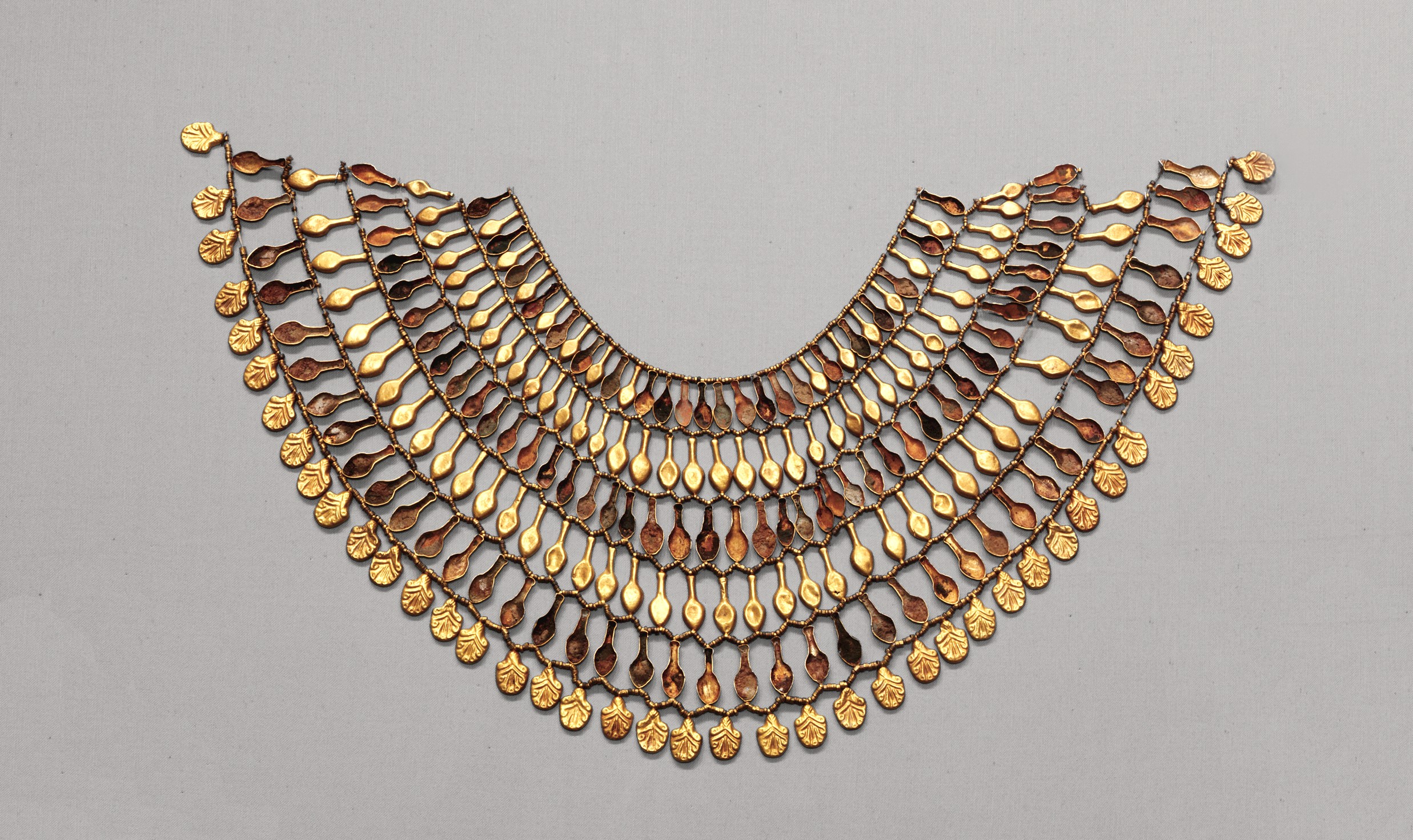
Because jewelry was and so universal and pervasive we can acquire a vast corporeality from studying even a single dewdrop. Yet much of the ancient jewelry pieces in modern collections, especially those gathered in the 19th and early 20th centuries, have little to no recorded archaeological context – pregnant they lack critical information for total understanding. These pieces too have often been trivialized as purely aesthetic rather than informative, marginalizing the potential and importance of studying jewelry. Instead of being dismissed, jewelry should be used every bit scholarly objects to amend empathize ancient Egypt. Burial trends, ritual practices, manufacturing skills and resources and material availability are just a few avenues to explore through jewelry. Such written report, in turn, can provide essential information on a range of topics, including trade, gender, class, economic science, military machine power and political dominance.
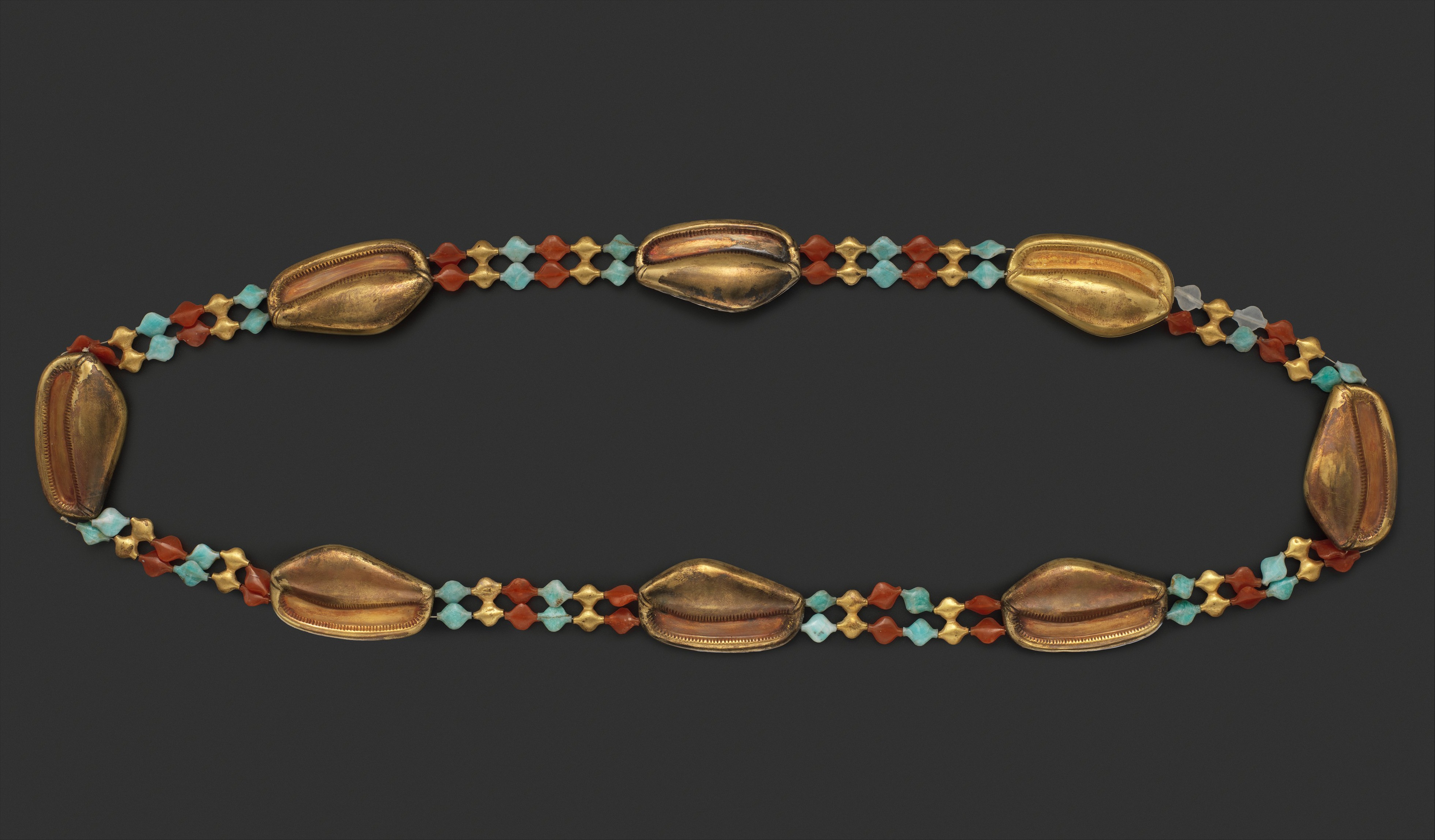
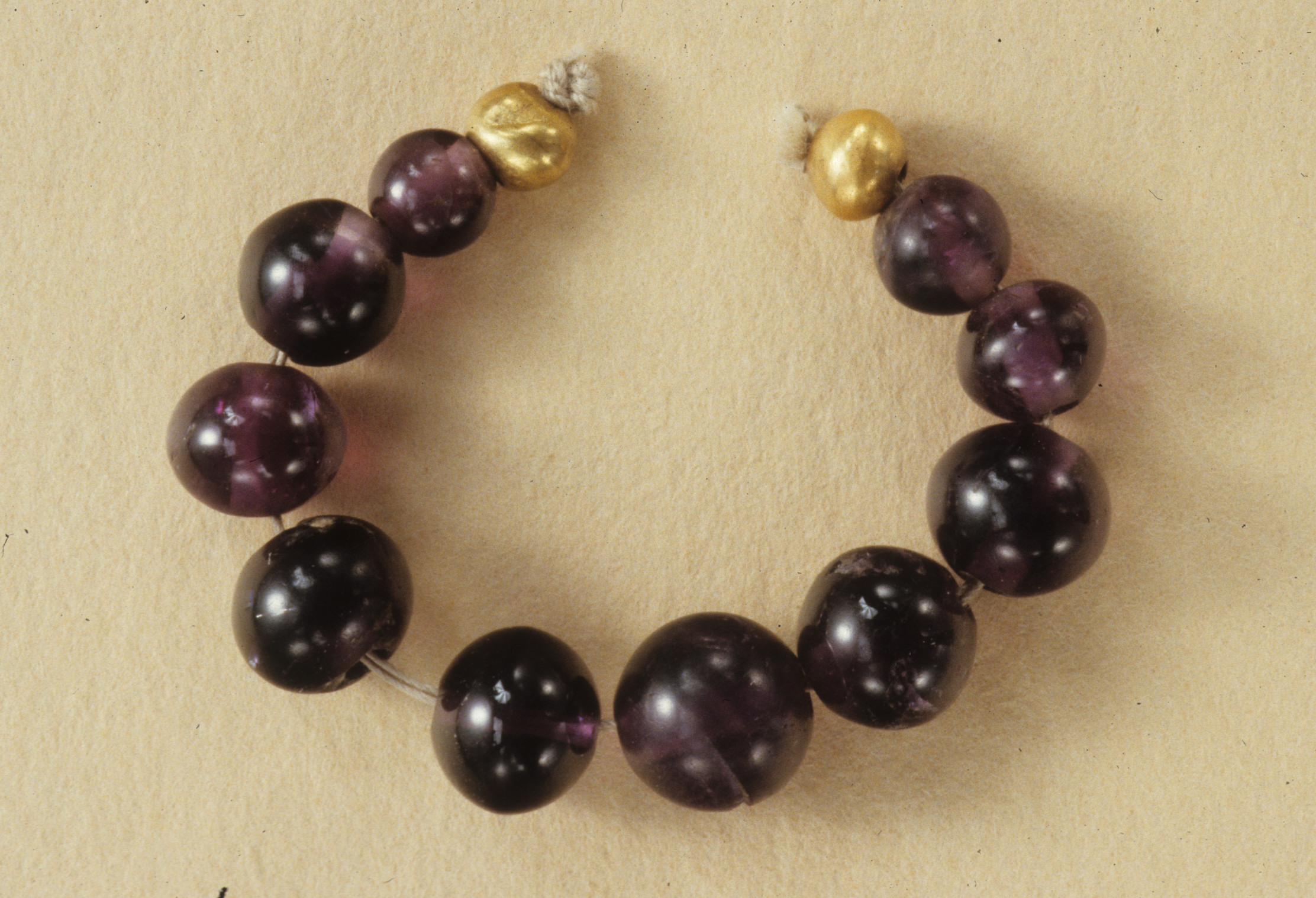
For Egyptian jewelry, styles, material choices, fabrication techniques and even object type and decorative meaning inverse over fourth dimension. Gemstones such as lapis and turquoise were imported and thus often less available during unstable political periods. Meanwhile, some locally bachelor materials were popular only during certain periods: Purple amethyst was the rage during the Middle Kingdom (ca. 2055-1650 BCE), while glass was used in some 18th-dynasty royal and elite jewelry, such every bit King Tutankhamun's pectorals and inlaid mummy mask.
Most Egyptians wore some type of jewelry during their lifetimes, and almost every Egyptian was cached with some form of adornment. The materials called and the quality of workmanship often marked the condition of the owner or wearer. The elaborate gold masks and inlaid pectorals of the 21st and 22nd-dynasty kings of Tanis (ca. 1069-945 BCE) and the intricate Heart Kingdom princess girdles and bracelets from their burials at Lahun and Dashur were of far different quality than a simple strung clay dewdrop institute in a poor individual's burial. Some simpler objects such as single strung barrel-shaped carnelian swr.t beads were also common in aristocracy burials.
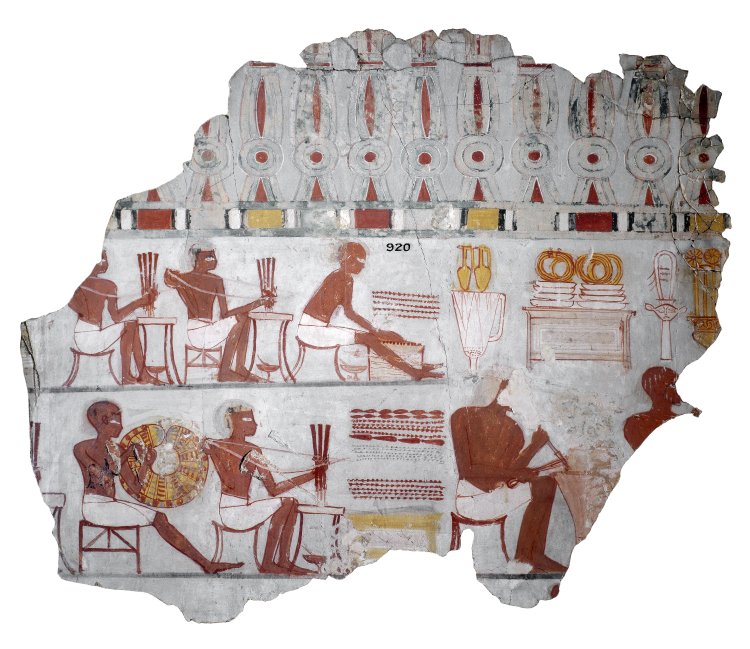
Regardless of quality, these were objects of brandish, protection and power. Most excavated jewelry comes from tombs or from a few temple foundation deposits. Aside from the objects themselves, nosotros can larn much from texts and images describing and depicting adornments. In fact, some jewelry types are known only from depictions on statues and reliefs. A few Egyptian jewelry workshops take been excavated, but most of what we know about ancient craftsmen and their techniques comes from tomb scenes. In the New Kingdom, tomb scenes of Sobekhotep and Rekhmire, some workmen drill beads with quadruple and triple bow drills while others string beads.
Jewelry was both decorative and purposeful. One dewdrop may reveal much, especially if archaeological context is known. Its material - ceramic, metal, certain stones - tin potentially be sourced and origin thus understood. Scientific assay, such as LA-ICP-MS (laser ablation-inductively coupled plasma-mass spectrometry) and x-ray florescence, allows for compositional assay and comparisons. Even the exact gemstone quarry or the precise location of Nile clay tin can sometimes be identified. Examining a bead under a microscope tin as well yield clues regarding composition and utilize. For instance, glass and glazed objects often produce visible bubbles; if a bead'southward piercing shows signs of clothing, information technology probably was worn and displayed before last deposit in a burial. Some jewelry was made strictly for burial, and bracelets and other adornments have been found simply laid on mummies without being fastened.
Jewelry often held apotropaic powers for its wearer - both living and expressionless. Color and material were pregnant, protecting the living from disease and danger and, wrapped inside a mummy's bandages, guarding the deceased for eternity. The Book of the Dead, the famed New Kingdom funerary document, prescribes specific materials for certain amulets and often detailed where on the body to include them. Chapter 156 called for red jasper for the girdle tie of the goddess Isis, which was placed on the pharynx of the mummy. Capacity 159 and 160 assigned green feldspar for papyrus amulets, and Chapter 30 prescribed what is believed to exist green jasper for the heart scarab. The heart scarab amulet was created to aid the deceased in the weighing of the middle ritual in which the justice of one's heart was weighed against the plume of truth/Maat.
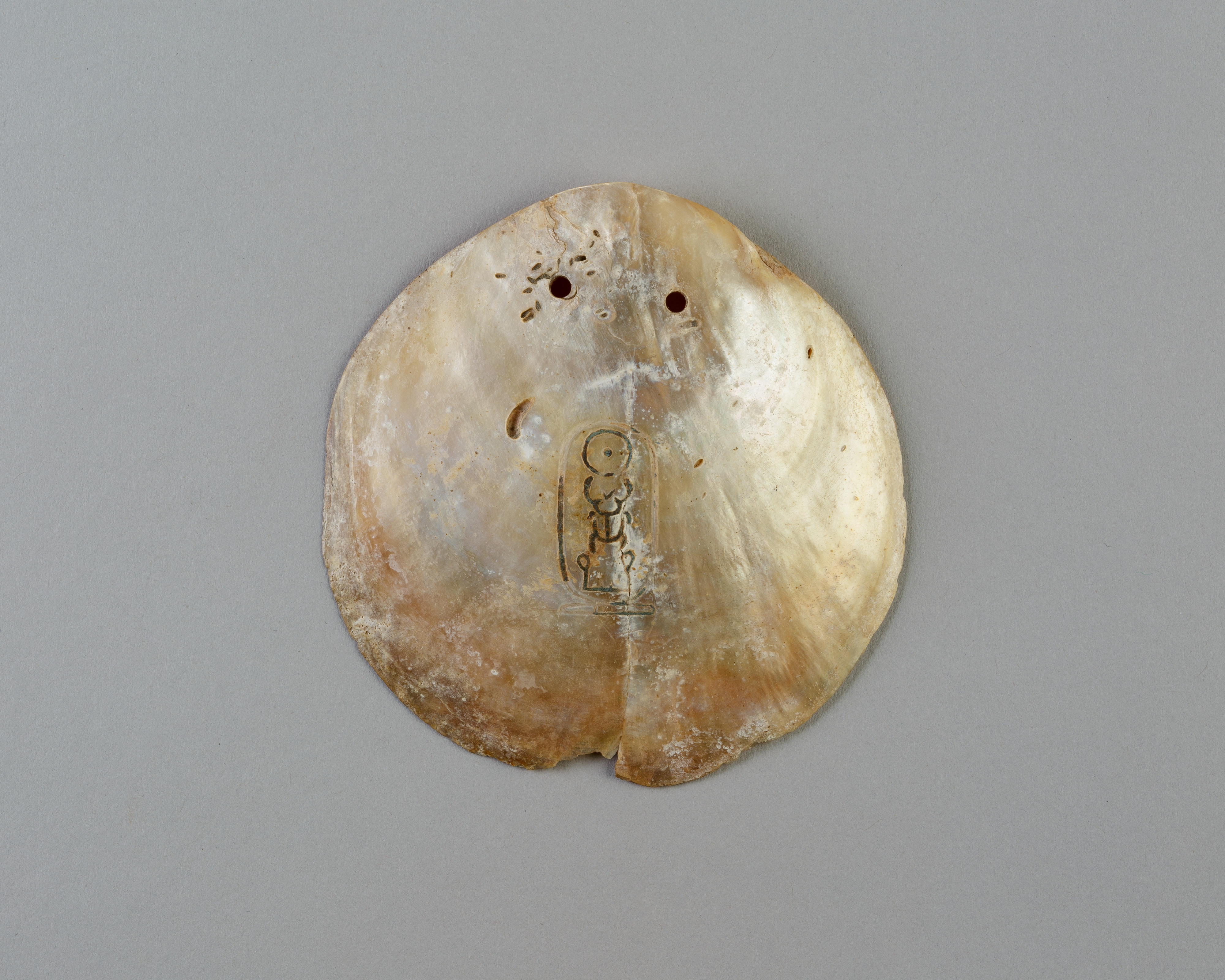
Kings bestowed favor and military honors through jewelry. Based on excavated examples from Nubia, pierced and polished oyster shells inscribed with the cartouche of Rex Senwosret I were probably worn past soldiers in the Eye Kingdom. In the 18th dynasty, fly-shaped "Golden Fly" pendants or "The Order of the Gilded Wing" were given as military rewards. Three large gold flies were found in the burial assemblage of Queen Aahhotep, female parent of 17th-dynasty Male monarch Ahmose and grandmother of King Amenhotep I, the founder of the 18th dynasty. She was lauded in Ahmose'due south Year xviii Karnak stela every bit a slap-up warrior who fought confronting the rebel Hyksos, and her gold flies are further show of her military machine prowess.
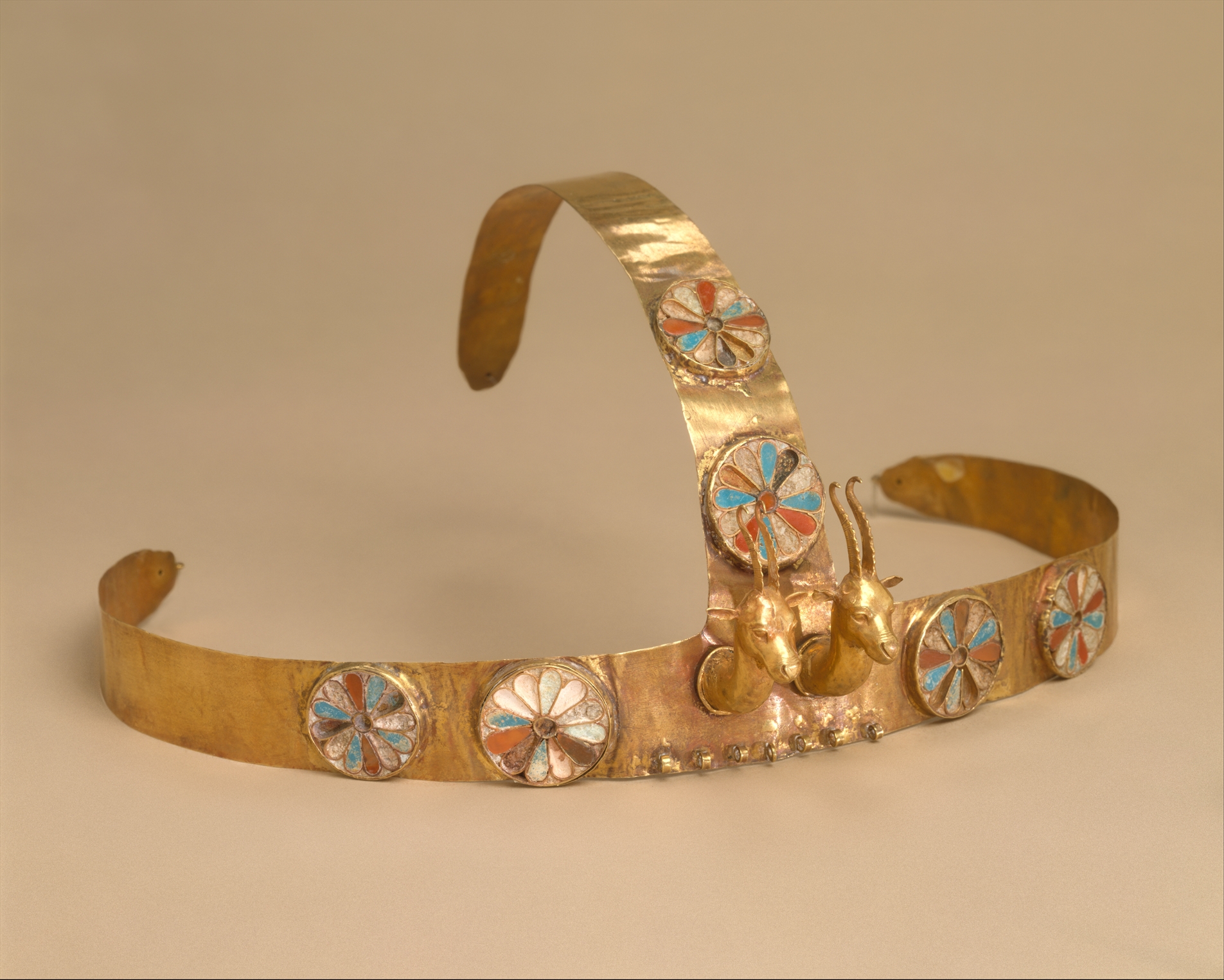
In relief at the Karnak Temple, king Thutmosis 3 listed and depicted the many rich gifts, including jewelry, he collected from his foreign campaigns and and then bestowed to the god Amun-Re. The campaign and general wealth from Thutmosis'southward reign is also reflected in the rich burying of three of his queens. The tombs of the "foreign queens" include necklaces, girdles, bracelets and crowns; pieces like this diadem have non-Egyptian motifs, supporting other evidence that these women were foreign-based.
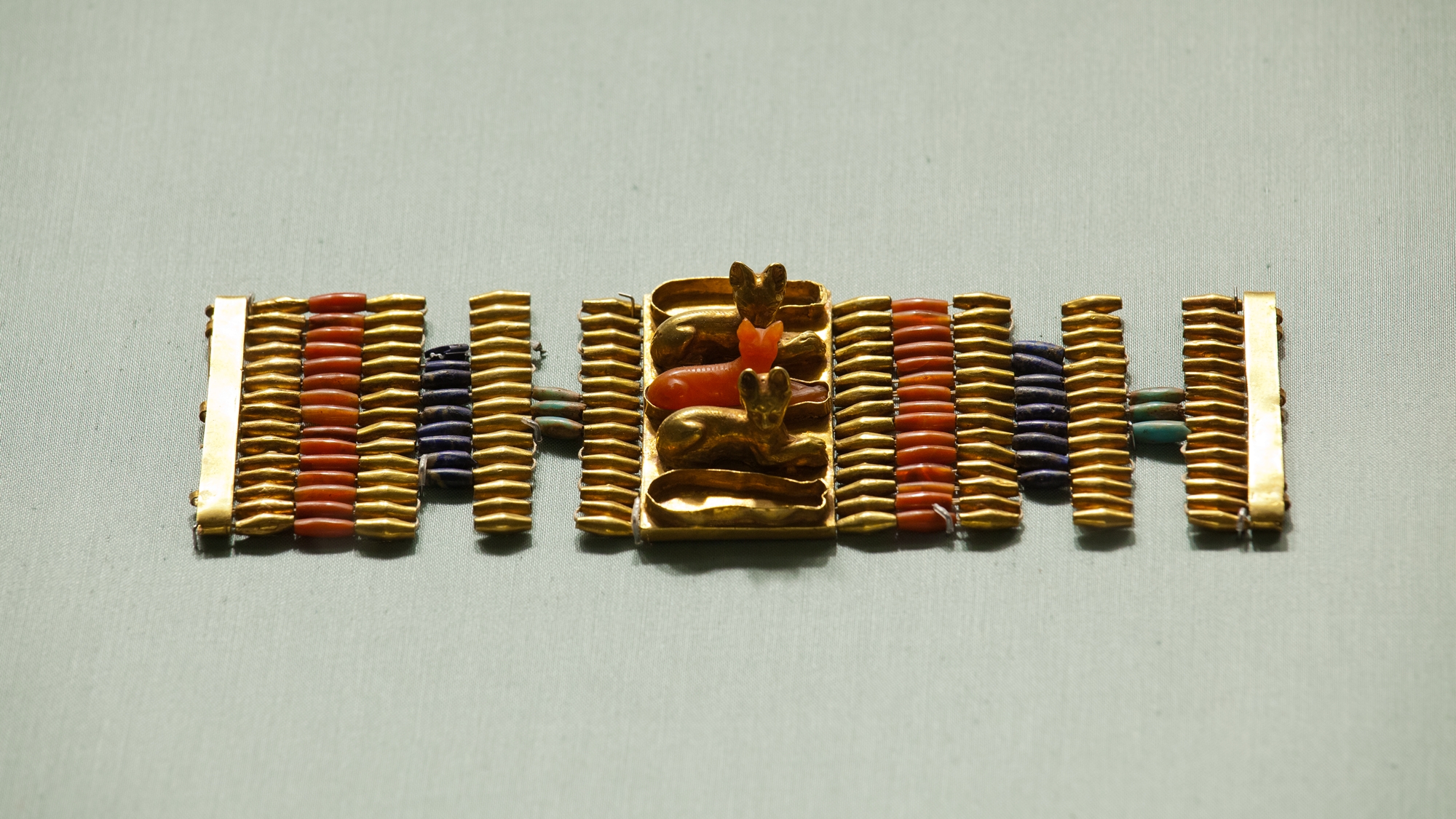
While kings usually bestowed gilt flies and shebyu necklaces during prosperous or victorious times, jewelry types can also reveal information about less stable political and economic situations. Jewelry is pocket-sized, transportable, often valuable and was thus unremarkably the first particular to exist snatched during tomb robberies, specially in artifact. To varying degrees throughout Egyptian history, metal adornments on mummies and in assemblages were illegally collected to exist melted downwards and recast. Ancient records, like the late-New Kingdom Amherst Papyrus, and P. BM 10068 item the crimes of 20th-dynasty tomb robbers in Thebes. Based on these and other texts, it seems jewelry robberies increased and became more than strategic as political centralization decreased towards the end of the New Kingdom.
Jewelry even can counter conventional wisdom. Third Intermediate Period (ca. 1069-664 BCE) openwork faience spacer beads include circuitous designs, which demonstrate exquisite skill. These were fabricated during a catamenia traditionally dismissed as declining and even chaotic politically and socially. Simply these beads suggest a different narrative. The regal and religious themes of these beads were once reserved for temple walls, and this change of medium demonstrates a change in religious behavior - or at least in religious decorum. By demonstrating artisans' sophisticated skills, they are further show of the demand for nuisance when studying and describing this complicated catamenia in Egyptian history.
Throughout ancient Arab republic of egypt, jewelry was offered at temples, buried in tombs, stolen from mummies, presented every bit gifts and rewards, and worn to the temple and tomb, as well as to the marketplace. Pocket-size, sometimes valuable and often intricate, jewelry presents intimate and important ways to study Egyptian culture.
Recommended Reading
Andrews, Carol. Amulets of Ancient Egypt. London: Published for the Trustees of the British Museum by British Museum Press, 1994.
Andrews, Ballad. Ancient Egyptian Jewelry. New York, Abrams, 1991.
Bianucci, Raffaella, Michael East. Habicht, Stephen Buckley, Joann Fletcher, Roger Seiler, Lena K. Öhrström, Eleni Vassilika, Thomas Böni, and Frank J. Rühli. "Shedding New Calorie-free on the 18th Dynasty Mummies of the Royal Builder Kha and His Spouse Merit." PLoS One. 2015; 10(7): e0131916. Published online 2015 Jul 22: https://www.ncbi.nlm.nih.gov/pmc/articles/PMC4511739/
Brand, Peter. "The Shebyu-Neckband in the New Kingdom, Role 1," Studies in Memory of Nicholas B. Millet, The Society for the Study of Egyptian Antiquity Periodical 33 (2006), 17-28.
Cifarelli, Megan. "Adornment, Identity, and Actuality: Ancient Jewelry in and Out of Context." Review Commodity on Masterpieces of Ancient Jewelry: The Field Museum of Natural History, Chicago, February 13-June 4 2009, in the American Periodical of Archæology Online Museum Review, Outcome 114, Jan 2010, pp. 1-9.
Gestoso, Singer, Graciela N. "Queen Ahhotep and the 'gilded fly'." Cahiers Caribéens d'égyptologie 12 (2009): 75-88.
Harrell, James. "Gemstones." UCLA Encyclopedia of Egyptology, 2012.
Lilyquist, Christine, with contributions past James E. Hoch and A.J. Peden. The Tomb of the Three Foreign Wives of Thutmose Iii. New York: Metropolitan Museum of Art, 2003.
Meskell, Lynn. "Individuals, Selves and Bodies." In Archaeologies of Social Life: Age, Sexual activity, Class et cetera in Ancient Egypt, 8-52, Oxford: Blackwell, 1999.
Miniaci, Gianluca, Susan La Niece, Maria Filomena Guerra and Marei Hack. "Analytical Study of the commencement royal Egyptian middle-scarab, attributed to the Seventeenth Dynasty king, Sobekemsaf." The British Museum Technical Inquiry Message vol. 7 (2013): 53-60.
Nicholas, Paul T. and Ian Shaw, eds. Ancient Egyptian Materials and Engineering science. Cambridge: Cambridge University Press, 2000.
Schorsch, Deborah. "The Tomb of Wah." Metropolitan Museum Online, 2004.
Troalen, Lore 1000., Jim Tate, and Maria Filomena Guerra. "Goldwork in Aboriginal Egypt: workshop practices at Qurneh in the 2d Intermediate Flow." Journal of Archaeological Scientific discipline. Book l, Oct 2014, Pages 219-226.
Xia, Nai. Ancient Egyptian Beads. Berlin, Heidelberg: Springer, 2014.
Source: https://www.arce.org/resource/egyptian-jewelry-window-ancient-culture
Posted by: lizotteesethe.blogspot.com
0 Response to "Did Sacred Animals In Egypt Wear Jewelry"
Post a Comment